




When to Apply Biostimulants for Abiotic Stress: Before, During, or After?
Oct.02.2026
Table of Content
[Hide]
Many biostimulant applications begin only after leaves wilt, scorch, or stop growing. By then, the crop may already have lost root activity, flowers, fruit, or productive canopy. For predictable abiotic stresses such as heat, drought, salinity, and transplant shock, the better question is not simply 'Which product?' but 'What should the product accomplish at this point in the stress timeline?'
The objective changes before, during, and after stress. Before stress, the program prepares the crop. During stress, it aims to maintain function without adding another burden. After stress, it supports recovery where viable tissue and yield potential remain. Biostimulants can support these objectives, but they do not replace irrigation, drainage, balanced nutrition, or basic crop protection.
Use Three Timing Windows
Timing Window | Primary Objective | Useful Indicators | Common Mistake |
Before stress | Prepare active roots and normal physiology | Forecast, soil moisture, crop stage, root activity | Waiting for severe injury |
During stress | Maintain function and avoid extra load | Canopy temperature, wilting, irrigation status, leaf condition | Applying concentrated or high-salt mixes under extreme conditions |
After stress | Support new growth and recovery | New roots, new leaves, flower or fruit retention, crop uniformity | Expecting dead tissue to recover |
Before Stress: Prepare While the Crop Can Still Respond
Preventive timing is most practical when the event can be anticipated: a forecast heat wave, a planned transplant, an irrigation interval, or a known period of saline water use. The crop should be actively growing and adequately hydrated so it can respond to the program.
At this stage, the agronomic foundation matters most. Correct irrigation scheduling, root-zone aeration, and nutrient balance first. A biostimulant may support root development, nutrient uptake, osmotic adjustment, or stress signaling, but it cannot create water that is not available or remove salts that continue to accumulate.
During Stress: Reduce Additional Load
During severe heat or water deficit, the crop may close stomata and reduce metabolic activity. Spraying at the hottest part of the day, increasing concentration to 'rescue' the crop, or adding several unfamiliar products can increase risk. Check crop condition, weather, label restrictions, spray-water quality, and the safest application window.
For chronic salinity, the root-zone environment remains central. Irrigation-water quality, drainage, leaching strategy, soil moisture, and electrical conductivity should guide the program. A foliar response alone does not show that the underlying salt problem has been corrected.
After Stress: Support Recovery, Not Reversal
Once conditions improve, evaluate what can still recover. Viable buds, active roots, new leaves, flowering, fruit retention, and canopy function are more useful indicators than the appearance of already damaged tissue. The treatment objective may be to re-establish root activity, restart growth, or protect the remaining reproductive potential.
Recovery programs should be proportional to crop value and remaining yield potential. In severely damaged fields, irrigation repair, pruning, replanting, or other agronomic decisions may matter more than another input.
Match the Window to the Stress and Crop Stage
Heat and drought often have forecastable windows. Transplant shock is predictable by definition. Salinity may be chronic and requires repeated root-zone monitoring. The same product schedule should not be copied across these stresses because the limiting process is different.
Crop stage changes the priority as well. A transplant is protecting establishment; a flowering crop is protecting pollination and fruit set; a fruiting crop is protecting fill, quality, and continued canopy function. Define the stage-specific outcome before choosing timing and rate.
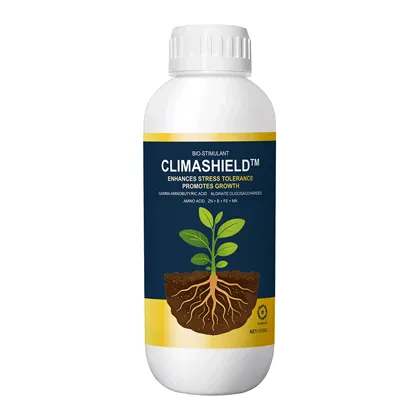
A CHICO Example: CLIMASHIELD®
CHICO's CLIMASHIELD® page lists amino acids, GABA, alginate oligosaccharides, and trace elements, and positions the product for root growth, nutrient absorption, crop vigor, and stress resistance. The current guidance includes transplanting, flower-bud differentiation, fruit setting, fruit development, enlargement, and coloring stages.
That broad positioning does not mean one rate or timing is ideal for every crop. The final program should follow the current product guidance and local registration, consider water quality and other tank partners, and begin with a representative local trial.
Conclusion
Biostimulant timing should follow the stress timeline. Prepare before a predictable event, protect normal function without adding load during stress, and support viable new growth after conditions improve. This approach gives the product a defined job and makes field evaluation more meaningful.
For crop-specific timing, contact CHICO with the crop stage, expected stress, irrigation method, water quality, and current input program.
FAQs
Should I wait for visible stress before applying a biostimulant?
Not necessarily. If the stress is predictable and the crop is actively growing, an earlier application may provide a more useful preparation window. Follow the product-specific recommendation.
Can a biostimulant replace irrigation during drought?
No. It may support crop responses, but it cannot replace the water required for plant survival and growth.
Does the best timing change by crop stage?
Yes. Establishment, flowering, fruit development, and recovery have different physiological priorities, so the application window and success measurements should change with the stage.
References
Related Agrochemical Products

CHOMONO® Chlorantraniliprole 2.5 % + Monosultap 30.5 % SC Insecticide
CLIMASHIELD® - Exclusive Bio-Stimulant to Boost Immunity and Enhance Stress Resistance
QUARTER® Penoxsulam 2.5%+Quinclorac 22.5% 25% SC Herbicide

MAXIUM Methoxyfenozide 24 % SC Insecticide
NORMANDY® Niclosamide 70%WP Insecticide
PERON® Penoxsulam 20%+ Ethoxysulfuron 10%WG Herbicide
DIPRO® Difenoconazole 150g/L+Propiconazole 150g/L 300g/L EC Fungicide
CHICO® Blue Elves NPK Liquid Compound Fertilizer